Articles of Articles of Agreement entered into this second day of December one thousand eight hundred and thirty between Julius Spencer on the one part and the Delaware + Raritan Canal Company by their President on the other part whereby it is covenanted and agreed as follows to wit.
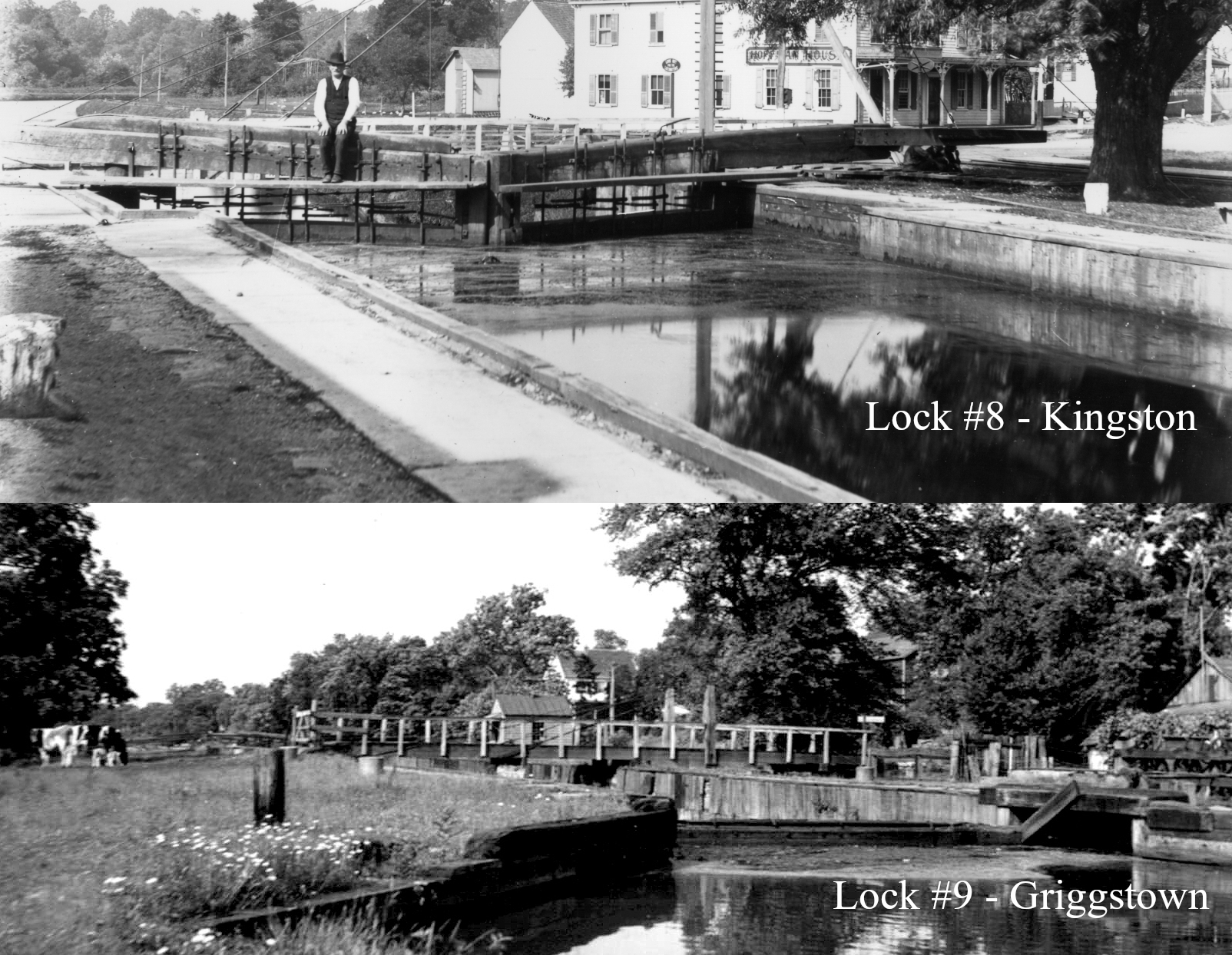
The said Julius Spencer covenants and agrees to construct and finish in every respect in the most substantial and workmanlike manner the Locks number eight and nine numbering from the Delaware River of the Delaware and Raritan Canal and to furnish all the materials except cement and iron. the walls to be not less than six feet thick at bottom and four feet thick under the coping with two offsets on the back of the walls of one foot each at such heights as shall be directed by the Engineer the walls to be not less than one hundred and fifty feet in length from the head to the ends of the wings measured in the center of the Locks.
The first six and a half feet from the foundation to be laid with large good shaped stone and to have placed in the face of the walls three range timbers six by ten inches square, secured in the walls by ties dovetailed into the range timbers, four feet long, and placed six feet apart. This part of the walls to be covered with good three inch white pine plank well spiked or treenailed.
All that part of the wall extending from the upper gates to the head of the Lock above the six and a half feet to be laid with good hammered or scabbled stone not less than ten inches in thickness except the upper two feet under the coping which shall be of cut stone. The remainder of the walls shall be of good cut stone of such quality as shall be approved of by the Engineer and to be laid in cement well backed with stone of large size and good shape and grouted at every course. The rough stone and scabbled work to be laid in cement and grouted.
Headers shall be provided for every course of stone not less than two feet wide and four feet in length at every eight feet in length of the walls. No face stone shall be less than ten inches thick nor less than twelve inches bed and no stone shall have less bed than face. The coping of the Lock walls to be cut stone three feet wide and one foot thick and not less than four feet in length. The hollow quoin coping to be four and a half feet square or cut from a stone of that size. The breast of the Locks to be of rough stone laid in cement and raised to within one foot of the bottom of the upper level of Canal and coped with a stick of oak timber twelve by sixteen inches square and to pass four feet into both side walls with a stick five feet long framed to each end and to project two feet beyond the head of the Lock into which pieces shall be placed bumping posts twelve by sixteen inches square and well secured to the Lock walls and to a stick or bumping timber on each side of the Lock extending to the Canal banks: there shall also be three additional sticks on each side and planked to support the embankment the planking to extend five feet below bottom water line of the upper level and an apron six feet wide to extend across the head of the Lock and fitted to the side planking and well puddled below and above the apron.
The timbers for the foundation must be at least twelve inches square and forty feet in length and laid two feet from centre to centre except under the mitre sills these to be placed side by side, the whole to be laid perfectly level and well bedded to prevent settling and the spaces between the timbers to be filled with good earth or gravel and well packed, two courses of pile plank or sheetpiling to be placed across the bottom four feet in length. One course of the head and the other under the lower mitre sill to be of two inch plank jointed. The whole foundation to be floored with good two inch plant jointed and well treenailed. After the lock walls are laid the chamber of the Lock is to be floored with good two inch white pine plank jointed and spiked to the foundation timbers the spikes to be at least eight inches in length. The mitre sills to be of good white oak timber eighteen inches wide and eight inches thick to be well secured to the foundation timbers with two inch treenails and one and a half inch iron bolts. The gates to be constructed of good white oak timber free from shakes or other imperfections and to be of such size and form as shall be directed by the Engineer with two valve gates in each gate of such size and form as the Engineer shall direct.
All the iron work except spikes to be furnished by the Company but to be put on by the said Julius C. Spencer as shall be directed by the Engineer. And the said Julius C. Spencer does hereby further promise and agree that he will from time to time during the progress of the work conform to such deviations + alterations in any part of the work as the Engineer may direct and the said Engineer may add to or diminish the amount of work in any of the Locks provided for in this agreement but if the contractor shall thereby incur any additional expense he shall be paid therefor such additional price as the said Engineer shall adjudge to be right and equitable.
And the said Julius C. Spencer does hereby further agree that if in the opinion of the Engineer he shall unreasonably neglect to prosecute the work hereby contracted to be done or shall perform the same or any part thereof imperfectly, or shall refuse or unreasonably neglect to do it over again or remedy such imperfection to the satisfaction of the said Engineer, he shall have power to determine that this contract has been abandoned and such determination shall exonerate the said Company from every obligation imposed upon them by this contract and they may immediately proceed to dispose thereof in such manner as if it had never existed.
And to avoid disputes as well as interruption and hinderances to the regular and peaceable progress of different parts of the work & to prevent unnecessary injury to the rights and property of the neighbors in the vicinity of the Canal the Engineer shall dismiss from the service of the Company every quarrelsome, disorderly person and such as shall be addicted to habits of intemperance or who shall wantonly commit any unnecessary trepass either upon the persons land or other property of the citizens living traveling or working upon the line of the Delaware and Raritan Canal. And every contractor shall dismiss all similar persons employed under him whenever thereto directed by the Engineer or assistant Engineer -
And further if at any time any mechanic or workman employed on said work shall be found unfaithful or believed to be so by the Engineer of said Company then in that case the said Engineer shall have power to direct that any such person is forthwith dismissed + no longer employed by the said contractor on any part of his work. And further if any bad or imperfect materials are brought upon the ground and disapproved of by the Engineer, they shall be forthwith removed to such distance from the work as shall be directed and if not attended to immediately by said Contractor said materials shall be removed at his expense by the direction of the Engineer. And the said Julius C. Spencer further promises and agrees to perform the several stipulations of this contract by himself and handle under his immediate superintedance and not by a sub contractor or contractors and to finish and deliver up this contract on or before the first day of [blank]
And he further promises and agrees that he will not giver or sell any ardent spirits to his hands or to any other person on or near the line of the Canal or allow any to be brought onto or near the works by the laborer or any other person. And the said Delaware and Raritan Canal Company do hereby promise and agree that they will provide all the cement and iron work except spikes, the cement to be delivered at the nearest convenient landing place or warehouse on the Raritan River. And will pay to the said Julius C Spencer for completing this contract as follows, for cut stone including the walls immediately back of it seven dollars per perch of twenty five cubic feet for hammered or scabbled work four dollars and seventy five cents per perch for rough stone work three dollars and thirty one cents per perch for coping one foot thick and three feet wide two dollars and fifty cents per foot [unintelligible] for furnishing and washing sand and transporting cement from Raritan River three hundred + fifty dollars per Lock- cutting hollow quoins for walls below top water line per Lock one hundred + seventy dollars – for timber work including foundation sheetpiling + gates – one thousand seven hundred and thirty two dollars, for excavation + embankment of Lock pits fifteen cents per cubic yard – pumping and boiling at the expense of the Company
And the said Company further agree that in order to enable the said contractor to carry on said work there shall be paid on or about the first day of each month after the commencement of the work such a sum as shall be certified by the Engineer for labor done and materials furnished at the Lock site [unintelligible]as to be perfect security for the said money paid.
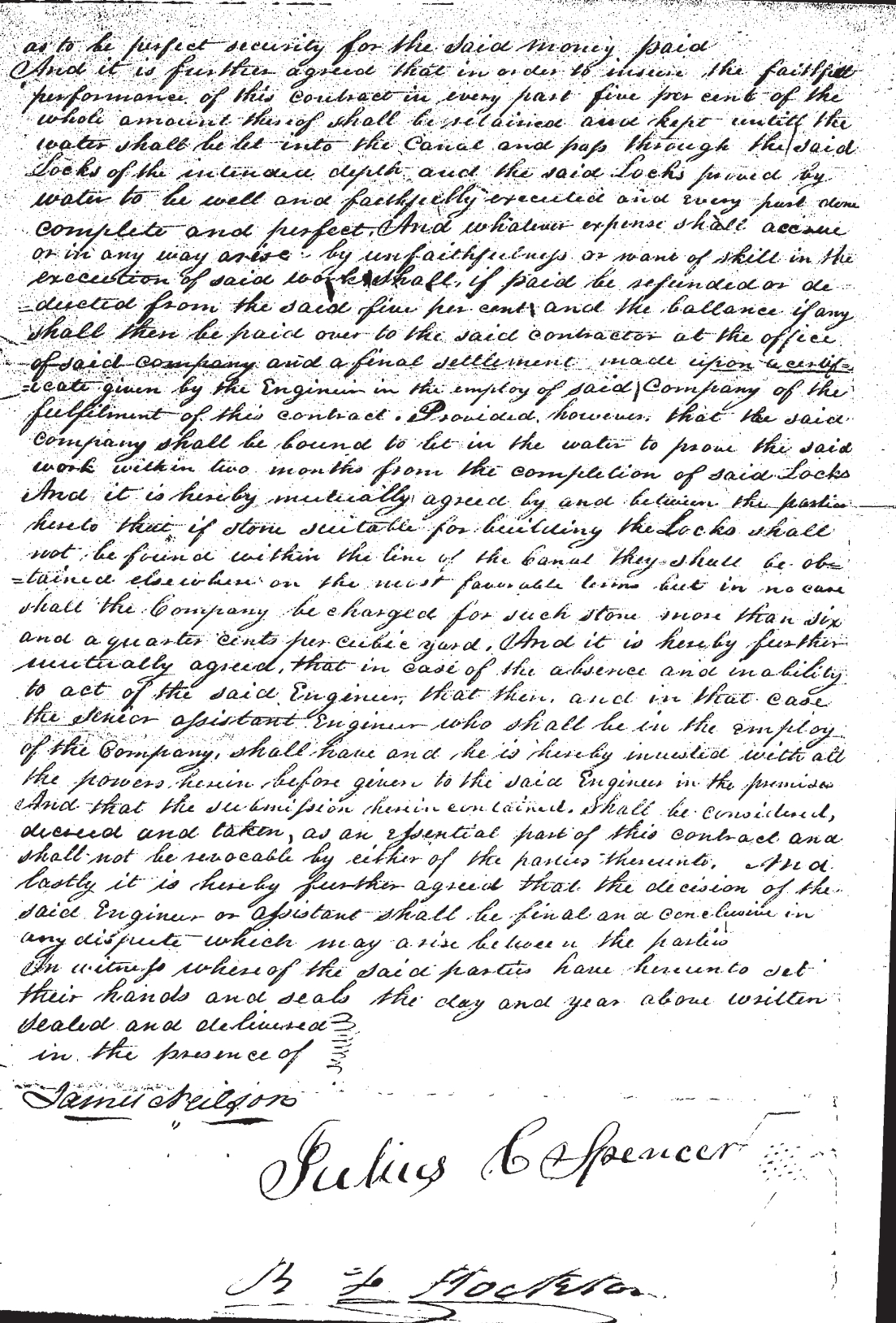
And it is further agreed that in order to ensure the faithful performance of this contract in every part five per cent of the whole amount thereof shall be retained and kept until the water shall be let into the Canal and pass through the said Locks of the intended depth and the said Locks proved by water to be well and faithfully executed and every part done complete and perfect. And whatever expense shall accrue or in any way arise by unfaithfulness or want of skill in the execution of said work shall if paid be refunded or deducted from the said five per cent and the balance if any shall then be paid over to the said contractor at the office of said Company and a final settlement made upon a certificate given by the Engineer in the employ of said Company of the fulfillment of this contract. Provided however, that the said Company shall be bound to let in the water to prove the said work within two months from the completion of said Locks And it is hereby mutually agreed by and between the parties hereto that if stone suitable for building the Locks shall not be within the line of the Canal they shall be obtained elsewhere on the most favorable terms but in no case shall the Company be charged for such stone more than six and quarter cents per cubic yard. And it is hereby further mutually agreed that in case of the absence and inability to act of the said Engineer that then and in that case the junior assistant Engineer who shall be in the employ of the Company shall have and he is hereby invested with all the powers herein before given to the said Engineer in the premises. And that the submission therein contained shall be considered decreed and taken as an essential part of this contract and shall be revocable by either of the parties there unto. And lastly it is hereby further agreed that the decision of the said Engineer or Assistant shall be final or conclusive in any dispute which may arise between the parties. In witness whereof, the said parties have hereunto set their hands and seals the day and year above written sealed and delivered in the presence of
James NeilsonJulius C Spencer
R F Stockton
EXPLANATION OF TERMS
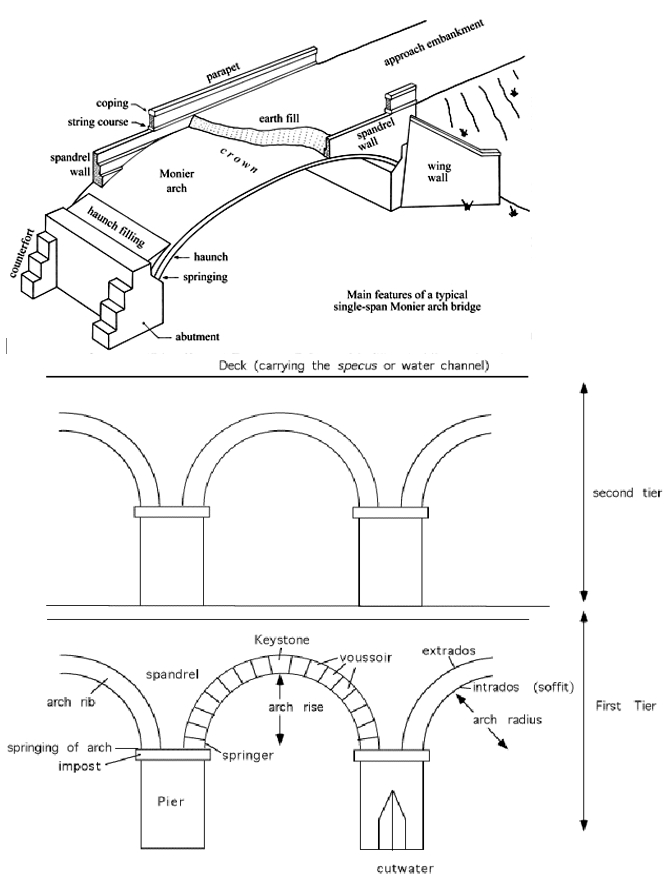
Coping:
Coping is the seal or protective covering that goes on top of walls, parapets, or boundary walls. This allows for a water-tight seal, thus preventing against water damage or weathering. Coping can be done with all types of materials, such as stone, brick, concrete, terracotta, tiles, or metals (aluminum, zinc, stainless steel, or copper).
Grubbing:
Grubbing occurs before any construction can start. Cleaning and grubbing refers to the process of removing all organic matter laying beneath the ground surface of the site. This can consist of removing tree roots, stumps, buried logs, heavy brush, or any other debris in the way. Without this process, the structure may become unstable over time due to new or old growth deteriorating the structure and allowing for cracks and shifting.
Hollow Quoin:
Originates from the French word “coin,” meaning corner. A hollow quoin is a stone that is used in the exterior corner of a wall or building to provide support to the structure. In terms of canals, hollow quoins are also a curved/rounded stone with which the mitre gate rests in, the curve allowing for it to open and close. At the base of the hollow quoin (the metal shape towards the upper right corner of the picture) is the foot box, which has a circular indent that the quoin post (possibly also called the gate pivot) sits in.
Perch:
A unit of measurement, sometimes called a rod, or a pole. It is equal to 16 ½ feet, or 5 ½ yards.
Puddling:
Puddling is the process of compacting soil, sand, clay, gravel, or other ground materials to provide a dense and stable ground surface to prevent water infiltration or leakage. The clay used in puddling is often called puddle clay, and is often laid at the bottom of the canal in several layers, and must be kept wet in order to remain impermeable.
Scabbled Stone:
A type of stone that has one or more rough edges, and may be of rough shape (also cobblestone or scabbled rubble).
Treenail
A wooden peg, dowel, or pin placed inside two pieces of wood to keep them together during construction.